What Is FDM 3D Printing? A Beginner's Complete Guide
Learn what FDM 3D printing is, how it works, what materials to start with, and where it falls short. A plain-English guide to fused deposition modeling for total beginners.
FDM 3D printing is the most popular and affordable way to turn digital designs into real objects at home. If you have ever seen a 3D printer in a school, a maker space, or a YouTube video, it was almost certainly an FDM machine.
FDM stands for Fused Deposition Modeling, a process where a plastic filament is heated, melted, and deposited layer by layer to build a solid object from the bottom up. It is the same technology whether you are using a $200 beginner printer or a $50,000 industrial system.
If you are brand new to 3D printing in general, start with our overview of what 3D printing is and come back here when you are ready to dive deeper into FDM specifically.
 Editorial Team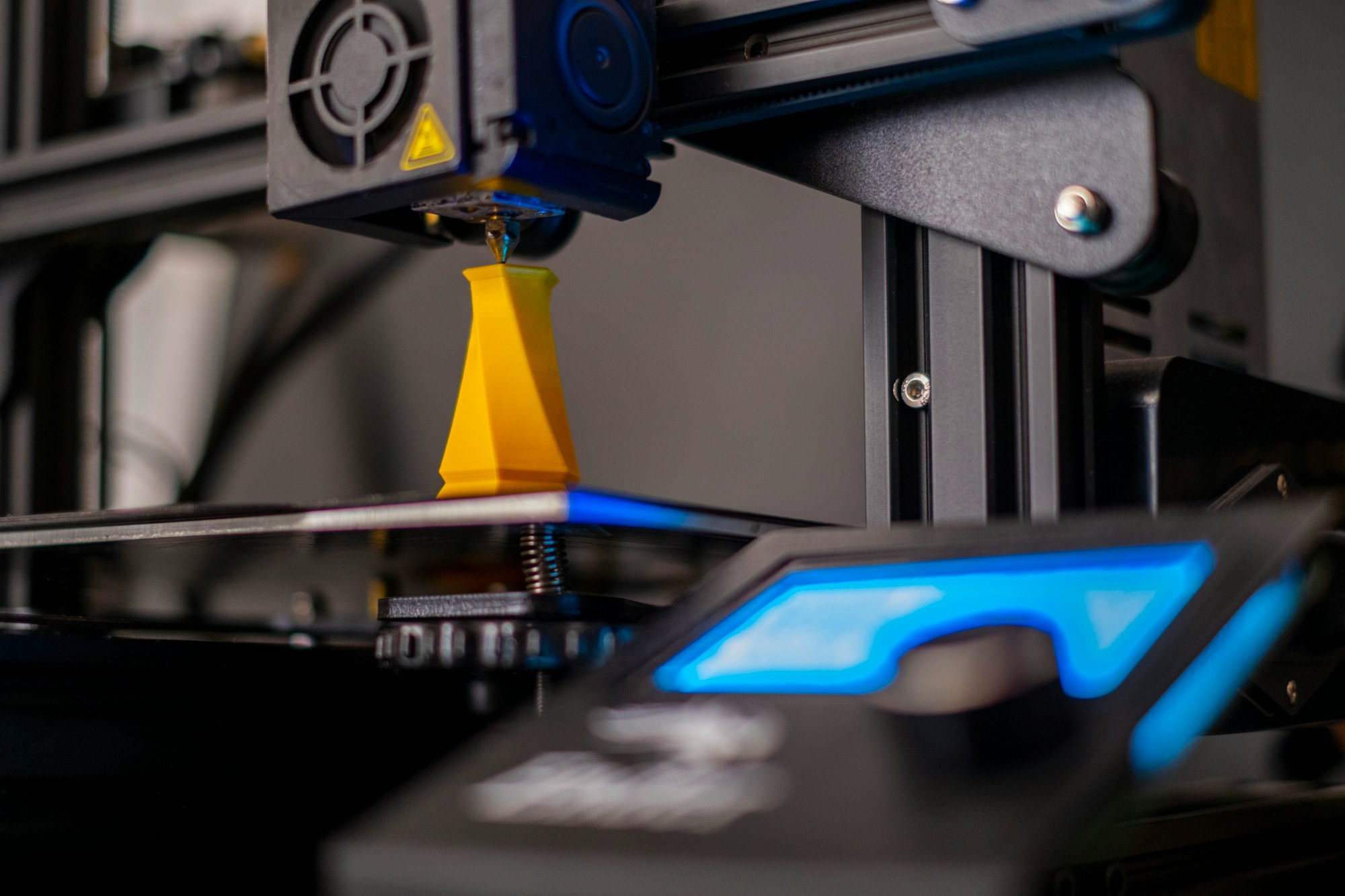
How Does FDM 3D Printing Work?
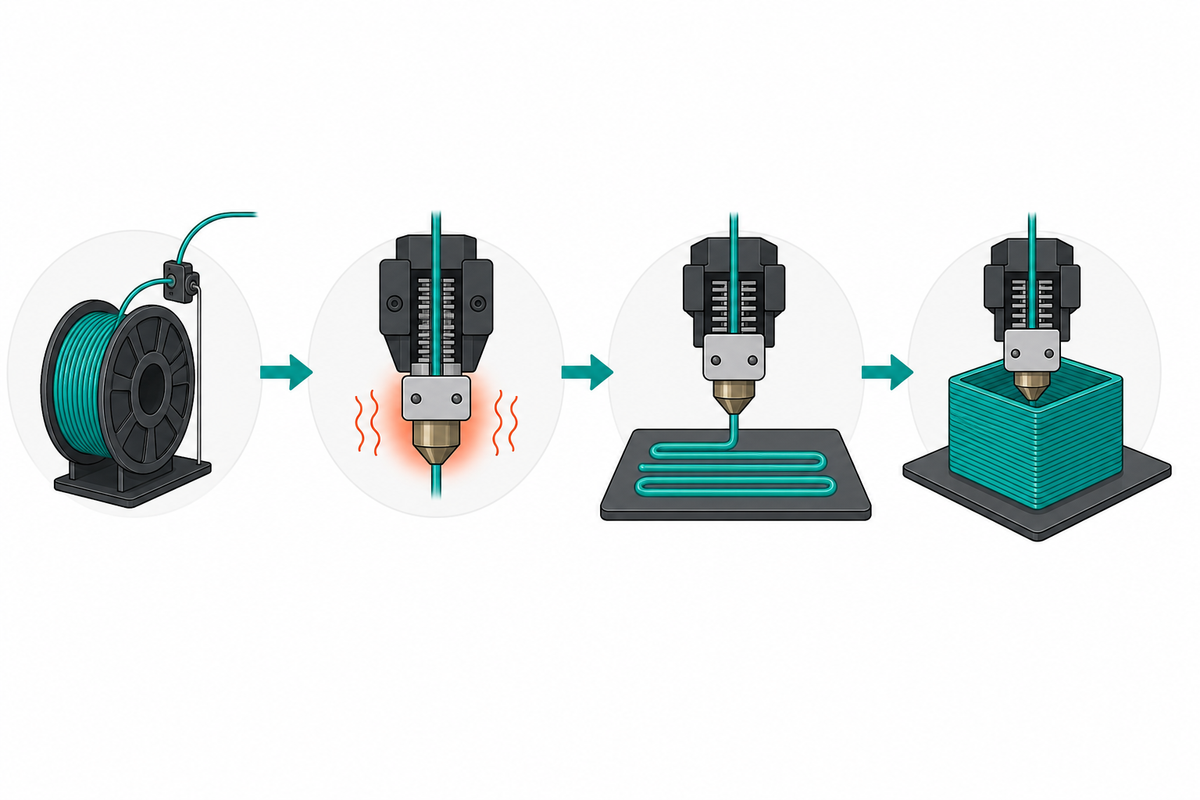
The simplest way to picture FDM: imagine drawing with a hot glue gun, except the movements are precisely controlled by a computer, and you are drawing thousands of layers on top of each other.
Here is the actual process:
- Filament feeds in. A spool of thermoplastic filament (usually 1.75 mm diameter) is loaded into the printer. A motor pushes the filament toward the print head.
- The nozzle melts it. Inside the print head, a heating element brings the filament to its melting point (around 200°C for PLA). The melted plastic is squeezed through a tiny nozzle, typically 0.4 mm wide.
- Layer by layer. The nozzle moves across the X and Y axes, depositing thin strands of molten plastic in the pattern determined by the slicer software. Each strand cools in seconds and bonds to the layer below.
- Build plate drops. After one layer is complete, the build plate moves down (or the print head moves up) by one layer height, usually 0.2 mm, and the next layer begins.
- Repeat. This cycle continues for hundreds or thousands of layers until the full object is built.
The entire process is automated. You set it up, hit print, and the machine runs unattended. A small object takes 30 minutes to an hour; larger prints can run overnight.
FDM vs. FFF: Why Are There Two Names?
You will see both "FDM" and "FFF" used interchangeably online. Here is why:
- FDM (Fused Deposition Modeling) is a trademark registered by Stratasys, the company that commercialized the technology in 1989.
- FFF (Fused Filament Fabrication) is the generic, open-source term created by the RepRap community so anyone could describe the same technology without trademark issues.
They are the exact same process. Most people say "FDM" because it is more widely recognized, and that is what we use throughout this site.
What Can You Make with an FDM Printer?
FDM is versatile enough for a wide range of projects:
- Household solutions: drawer organizers, wall mounts, custom brackets, replacement parts for appliances
- Toys and games: articulated dragons, chess pieces, board game inserts, fidget toys
- Cosplay and props: helmets, masks, armor sections (printed in parts and assembled)
- Functional prototypes: test-fit parts before committing to expensive manufacturing
- Tools and jigs: custom wrenches, drill guides, soldering holders, phone stands
- Education: anatomy models, mechanical demonstrations, architecture prototypes
FDM is at its best when you need something strong enough to handle, large enough to hold, and cheap enough to reprint if the design needs changes.
Common FDM Printing Materials for Beginners
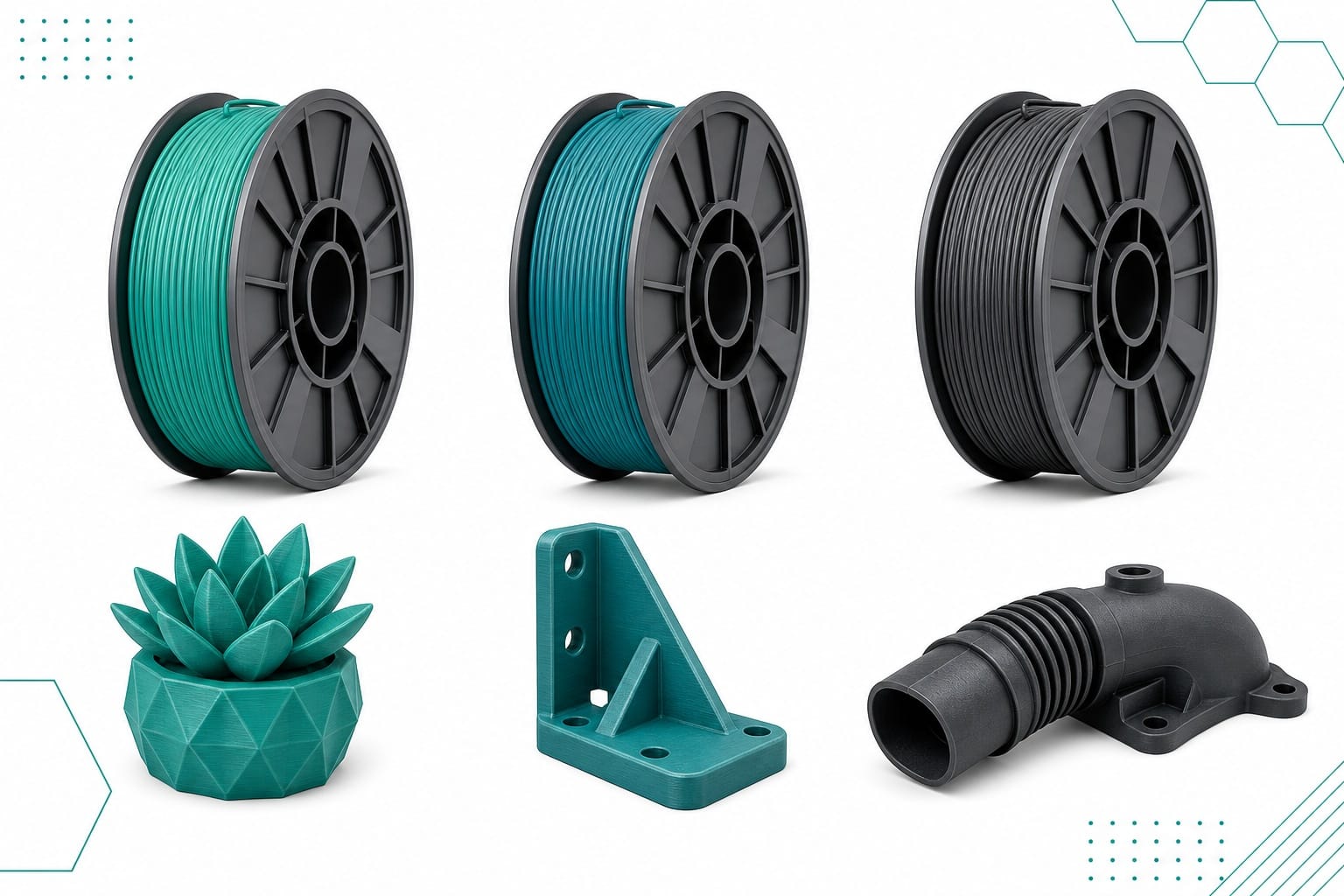
One of FDM's strengths is the sheer variety of materials available. But as a beginner, you only need to know three:
| Material | Difficulty | Strength | Best For |
|---|---|---|---|
| PLA | Easiest | Moderate | Learning, display models, prototypes |
| PETG | Easy | Good | Functional parts, anything near water |
| ABS | Harder (needs enclosure) | Good | Heat-resistant parts, automotive |
Start with PLA. It prints at low temperatures, does not warp easily, produces no harmful fumes, costs around $20 per kilogram, and works on every FDM printer without special equipment. After you are comfortable with PLA, try PETG for parts that need more durability.
Beyond these three, the FDM material world includes TPU (flexible, like rubber), Nylon (very tough), ASA (UV-resistant for outdoor use), and composite filaments with carbon fiber or wood particles. But those all come later.
PLA is not the same thing as FDM. PLA is a material; FDM is the printing technology. You will see this confusion online, but now you know the difference.
FDM vs. SLA vs. SLS: A Quick Comparison
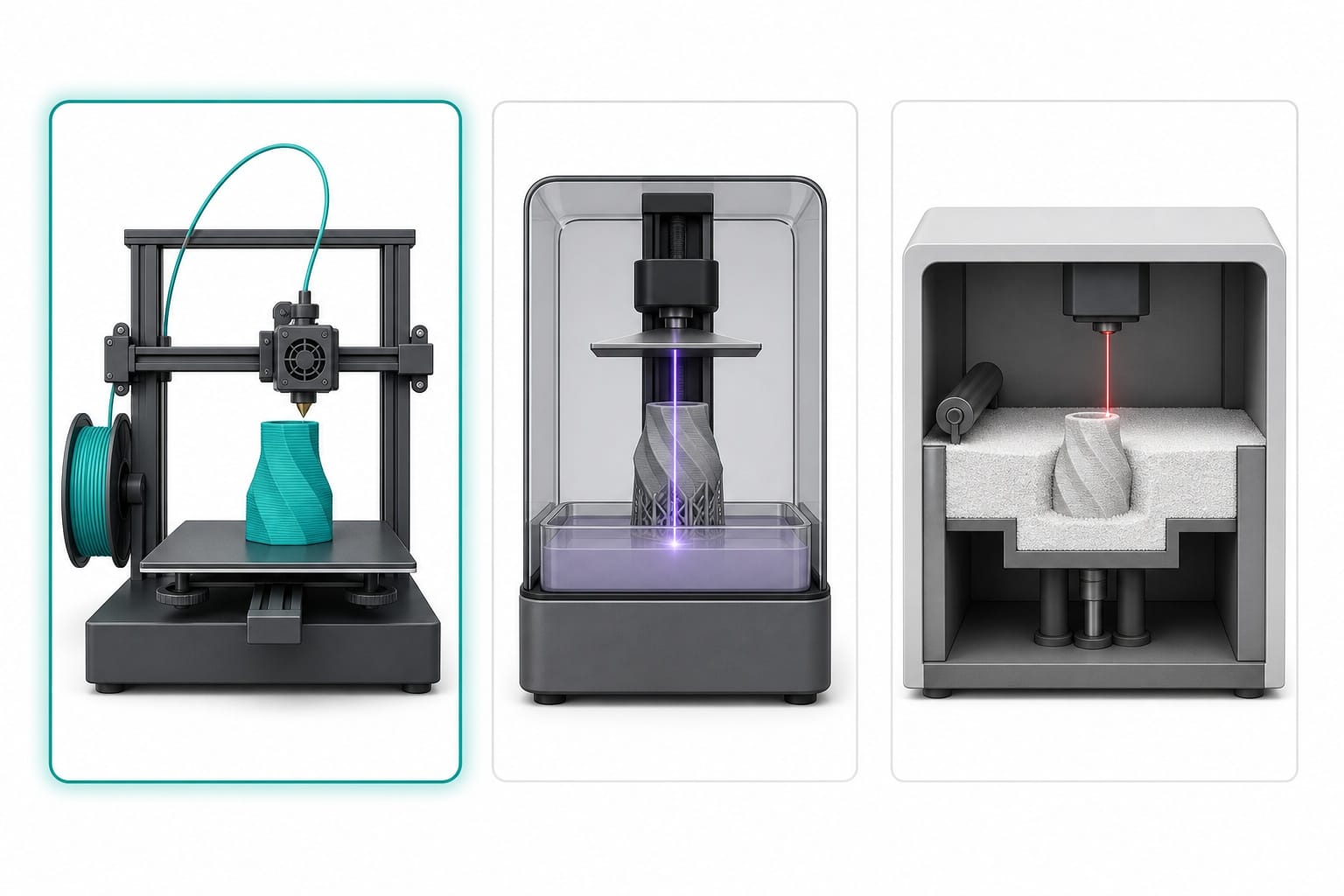
FDM is not the only 3D printing technology. Here is how it stacks up against the other two you will encounter:
| Category | FDM | SLA (Resin) | SLS (Powder) |
|---|---|---|---|
| Cost to start | $200–$500 | $200–$500 | $30,000+ |
| Ease of use | Easiest | Moderate (chemicals) | Complex |
| Surface finish | Visible layer lines | Very smooth | Slightly grainy |
| Detail level | Good | Excellent | Very good |
| Strength | Good | Moderate | Excellent |
| Best for beginners? | Yes | Second printer | No (industrial) |
| Best use case | Functional parts, prototypes, large objects | Miniatures, jewelry, dental | Engineering parts, production |
Bottom line: FDM gives you the best balance of cost, ease, material variety, and part strength for a beginner. SLA wins on detail if you specifically need smooth miniatures or jewelry-quality pieces. SLS is a different price category entirely.
Advantages and Limitations of FDM
Advantages
- Lowest cost to start: good printers under $300, materials under $25/kg
- Easiest to learn: simplest workflow of any 3D printing technology
- Widest material selection: dozens of thermoplastics for different needs
- Large prints possible: build volumes up to 300x300x400 mm on consumer machines
- Huge community: endless tutorials, troubleshooting help, free model files
- Safe for home use: PLA printing requires no special ventilation or chemical handling
Limitations
- Visible layer lines: FDM surfaces are not smooth out of the printer. Post-processing (sanding, painting) helps but adds time.
- Weaker between layers: parts can delaminate along layer boundaries under stress. FDM parts are anisotropic (stronger in some directions than others).
- Limited fine detail: minimum feature size is around 0.8 mm. Tiny text or intricate surface textures will not come out cleanly.
- Overhangs need supports: anything extending beyond ~45° from vertical needs support structures that leave marks when removed.
- Not watertight by default: layer boundaries create micro-gaps. Printing watertight objects requires specific settings and testing.
FDM is the right choice when you need parts that are strong enough, big enough, and cheap enough. It is not the right choice when you need jewelry-smooth surfaces, micron-level accuracy, or production-ready cosmetic finish.
Is FDM 3D Printing Worth It for Beginners?
Yes. FDM is the recommended starting point for almost every beginner, and for good reason: the barrier to entry is the lowest of any 3D printing technology, the running costs are minimal, and the learning resources are practically unlimited.
A complete starter setup (printer, a few rolls of PLA, basic toolkit) runs $250 to $500. That gets you a capable machine that can produce functional objects for years.
Frequently Asked Questions
What is FDM in 3D printing?
FDM (Fused Deposition Modeling) is a 3D printing process that builds objects by melting plastic filament and depositing it layer by layer through a heated nozzle. It is the most common and affordable type of 3D printing.
Are FDM and PLA the same?
No. FDM is the printing technology (the process). PLA is one of many materials (filaments) you can use with an FDM printer. Other FDM materials include PETG, ABS, TPU, and Nylon.
Which is better, SLA or FDM?
It depends on what you need. FDM is cheaper, easier, and better for large functional parts. SLA produces smoother, more detailed prints but costs more to run and involves liquid chemicals. Most beginners start with FDM.
Is FDM better than other 3D printing methods?
FDM is the best choice for beginners on a budget who want functional, reasonably strong parts. It is not the best for ultra-fine detail (SLA wins there) or industrial-strength production parts (SLS wins there). Each technology has its place.