Large Format 3D Printer: Best Picks for Beginners in 2026
A large format 3D printer lets you print full-size helmets, large functional parts, and batch jobs without splitting models. This guide compares the best options across every budget and use case.
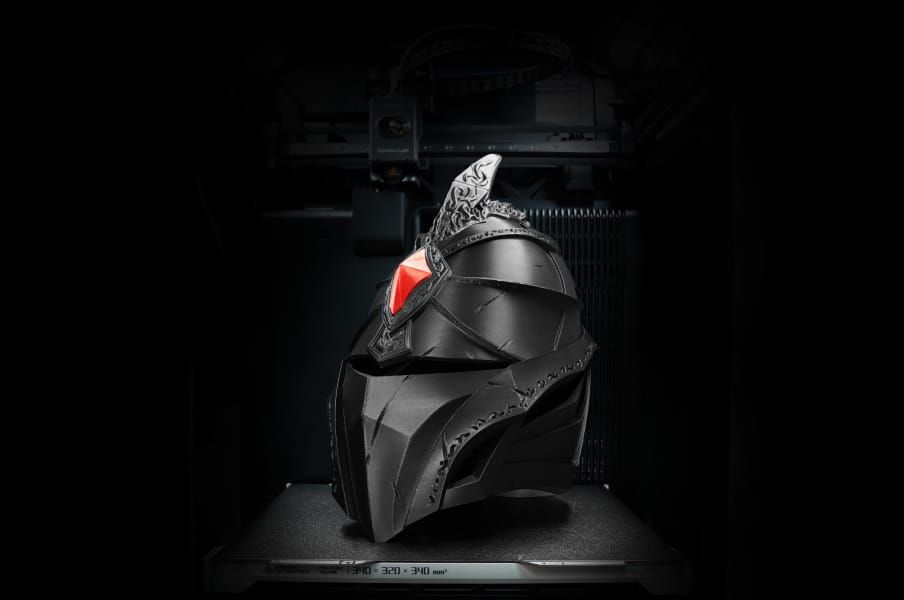
Your standard 256 mm printer can handle phone cases and small tools. But the moment you want a full-size cosplay helmet, a large functional bracket, or a batch of 30 items in one run, you hit the size limit. That's when a large format 3D printer earns its place.
In 2026, large format printing starts at $350 and goes up to $2,000 for a fully loaded all-in-one machine. This guide walks through the best pick for every budget and use case, starting with the two we recommend most.
What Is a Large Format 3D Printer?
There's no official industry definition, but the commonly accepted tiers are:
- Standard desktop: 220-256 mm per axis (Bambu Lab A1, Ender 3, Prusa MK4)
- Large format: 300 mm+ in at least one dimension (this article's focus)
- Extra large / Industrial: 500 mm+ per axis (workshop and factory machines)
The number that matters is build volume (Width x Depth x Height), not the machine's physical footprint. A large build volume 3D printer with 330 mm per axis gives you over double the printable space of a standard 256 mm machine.
For beginners, the 300-400 mm range is the sweet spot: big enough for one-piece helmets and large functional parts, while still fitting on a desk.
Best Large 3D Printer for Beginners: Bambu Lab A2L
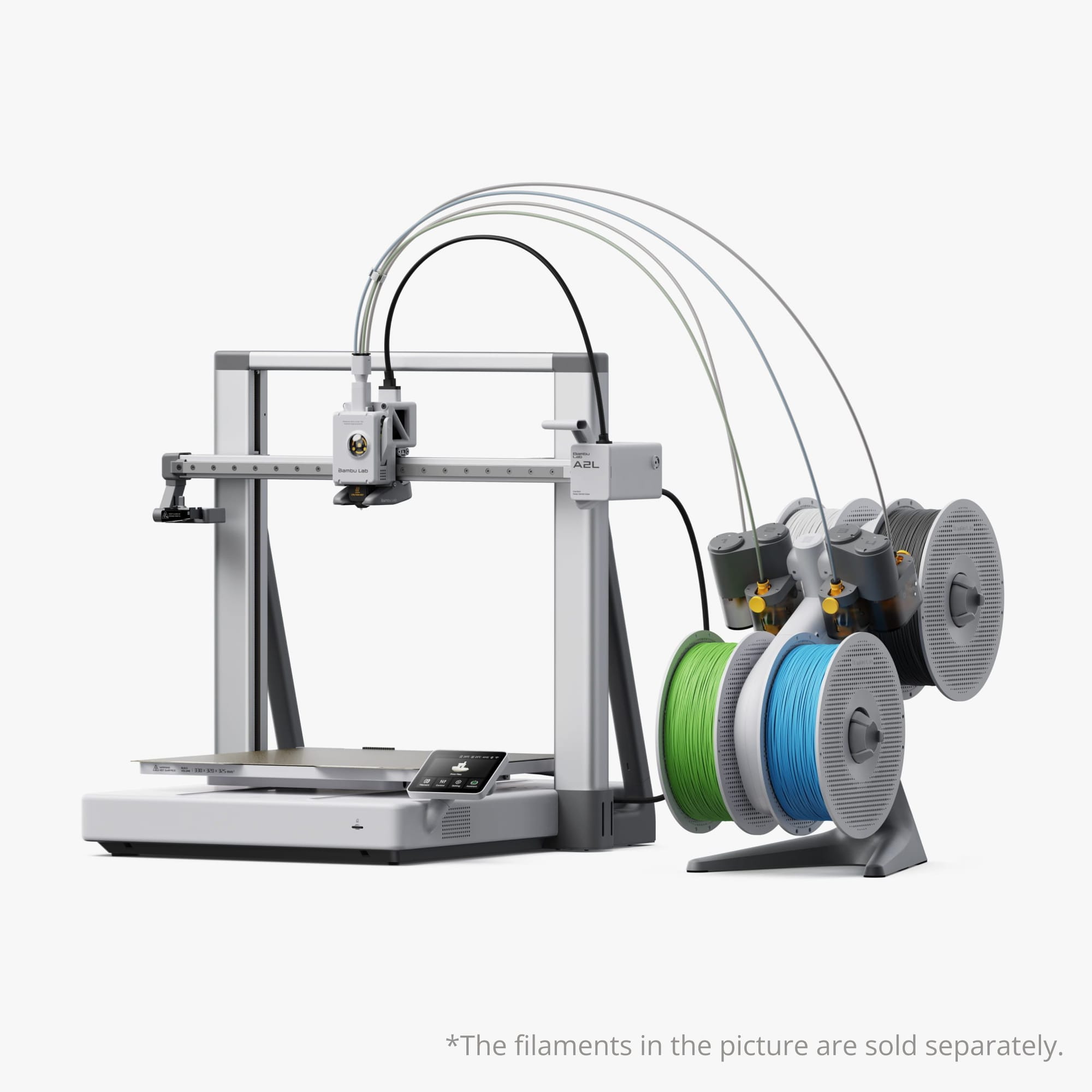
The Bambu Lab A2L is the most affordable large-format 3D printer designed specifically for beginners in 2026. At $469 (or $569 with the AMS Lite Combo for multi-color), it delivers a 330 x 320 x 325 mm build volume with fully automatic calibration, one-touch setup, and zero learning curve.
That 330 mm build volume is 105% more printing space than standard 256 mm printers. A full-size adult helmet prints in one piece. A batch of 40 fidget toys fits on a single plate. Models that previously needed splitting and gluing now print whole.
- Build Volume: 330 x 320 x 325 mm
- Price: $469 / $569 (AMS Lite Combo)
- Max Speed: 500 mm/s
- Nozzle Temp: Up to 300°C | Bed Temp: Up to 80°C
- Enclosure: Open frame
- Materials: PLA, PETG, TPU, PVA
- Multi-color: Up to 19 colors (chained AMS)
- Noise: < 49 dB (silent mode)
- Extras: Blade cutting module, pen plotting module
Why it's our #1 pick: Unbox, plug in, load filament, print. No manual bed leveling, no firmware configuration. The auto-calibration handles everything. The touchscreen guides setup in under 10 minutes. If you've never owned a 3D printer before, this is the easiest large format experience available.
The optional blade cutting module (~$60) cuts vinyl and paper. The pen plotting module draws on flat surfaces. These make the A2L genuinely versatile beyond 3D printing, especially for families and educators.
Limitations: Open frame and 80°C bed mean PLA and PETG only. No ABS, Nylon, or carbon fiber without an aftermarket enclosure.
Best All-in-One Big 3D Printer with Laser: Bambu Lab H2S
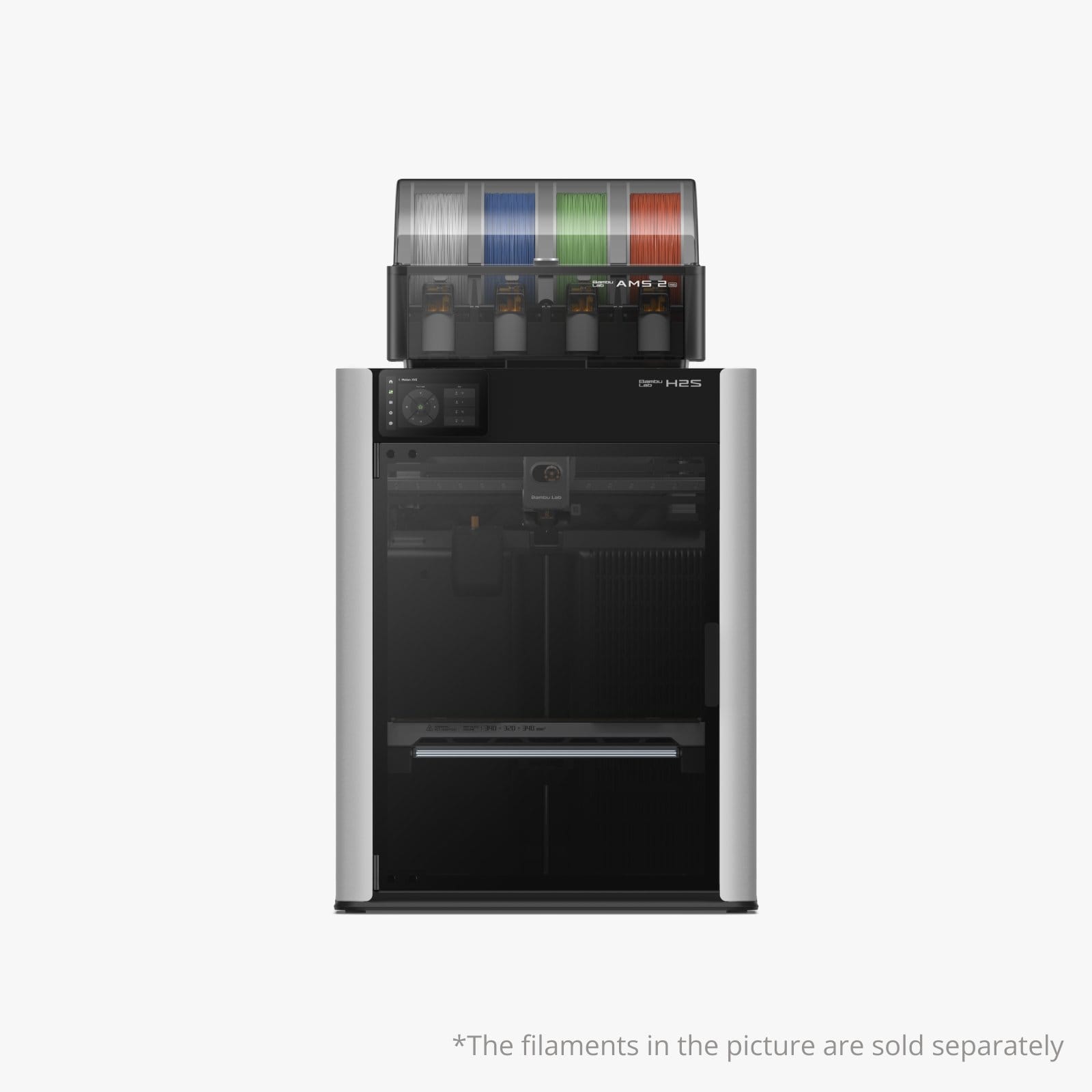
The Bambu Lab H2S is more than a large 3D printer. It combines large-format 3D printing, 10W laser engraving/cutting, and engineering-material support in one enclosed desktop machine. At $1,199 (base) to $1,799 (Laser Full Combo), it replaces multiple workshop tools.
- Build Volume: 340 x 320 x 340 mm
- Price: $1,199 / $1,399 (AMS) / $1,799 (Laser Full Combo)
- Max Speed: 1000 mm/s
- Nozzle Temp: Up to 350°C | Bed Temp: Up to 120°C
- Enclosure: Fully enclosed, 65°C active chamber heating
- Materials: PLA, PETG, PVA, PET, ABS, ASA, PC, PA, TPU, CF/GF reinforced polymer
- Multi-color: Up to 24 colors (chained AMS)
- Laser: 10W 455nm (cuts 5mm wood, engraves leather/cork/wood)
- Precision: DynaSense servo motors + Vision Encoder (< 50μm)
3D printing + laser in one machine: The 10W laser module clips onto the toolhead and works through Bambu's software. Print a custom box, then laser-engrave a logo onto it without moving the part. It cuts thin plywood (up to 5mm), engraves wood, leather, and cork. For makers, small businesses doing personalized products, or anyone combining printed and laser-cut parts, this hybrid workflow saves money and desk space.
All materials, no compromises: The 65°C heated chamber means ABS, Nylon, polycarbonate, and carbon-fiber composites all print reliably at large scale. No warping, no cracking, no aftermarket enclosure needed.
Who it's for: Makers wanting one machine that does everything. Creators combining 3D printed and laser-cut parts. Engineers needing high-performance materials. Small businesses producing personalized products.
Bambu Lab A2L vs H2S: Which Large Format 3D Printer Should You Pick?
| Factor | A2L ($469-569) | H2S ($1,199-1,799) |
|---|---|---|
| Build Volume | 330 x 320 x 325 mm | 340 x 320 x 340 mm |
| Materials | PLA, PETG, TPU, PVA | Everything including PA-CF, PC |
| Enclosed | No | Yes (65°C active heating) |
| Speed | 500 mm/s | 1000 mm/s |
| Laser | No (blade cutting only) | Yes (10W, cuts wood/engraves) |
| Precision | Standard | Vision Encoder < 50μm |
| Multi-color | Up to 19 colors | Up to 24 colors |
| Best for | Budget beginners | All-in-one maker machine |
Quick decision:
- You mainly print PLA/PETG and want large format at the lowest price → A2L
- You want 3D printing + laser engraving/cutting in one machine → H2S
- You need ABS, Nylon, or carbon fiber materials → H2S
- You're brand new to 3D printing → A2L (learn the basics, size up later if needed)
- You want one machine that handles everything for years → H2S
Best Budget Large Build Volume 3D Printer: Elegoo Neptune 4 Plus
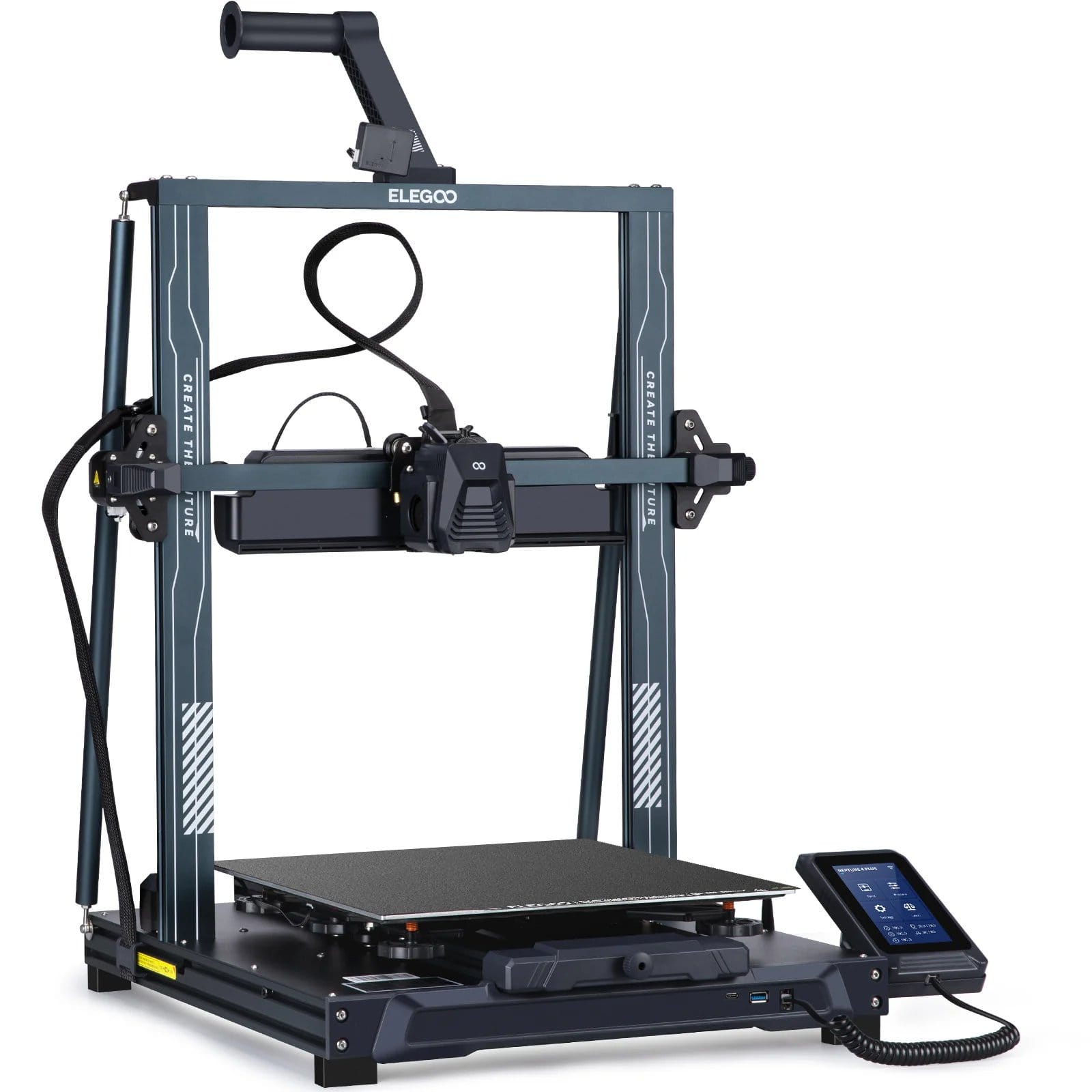
If the A2L is above your budget, the Elegoo Neptune 4 Plus is the cheapest path into large format at ~$350.
- Build Volume: 320 x 320 x 385 mm
- Price: ~$350
- Max Speed: 500 mm/s (Klipper)
- Key Features: Direct drive, auto leveling, dual Z-axis, 300°C nozzle
The taller Z height (385 mm vs A2L's 325 mm) matters for vases, tall figurines, and standing props. Klipper firmware delivers real speed improvements out of the box. The dual-sided build plate (smooth PEI + textured PEI) handles PLA and PETG well.
The tradeoff vs the A2L: 30-45 minute assembly required, no auto-calibration magic, and more manual tuning to get optimal results. You save $100-200 but invest more of your own time.
Pick this if: Hard budget cap under $400 and you're comfortable with a bit more hands-on setup.
Best Large Format FDM 3D Printer for Maximum Size: Anycubic Kobra 3 Max
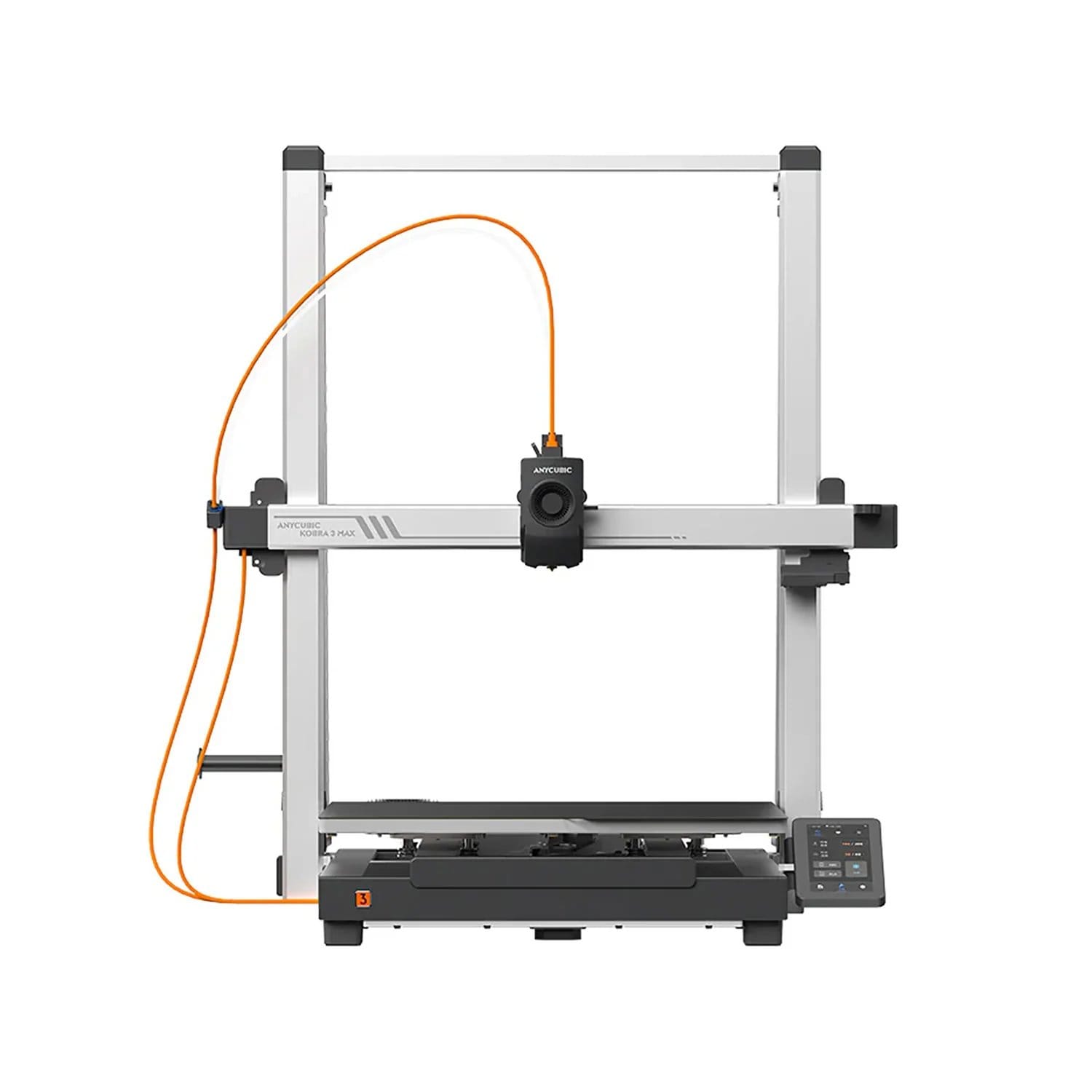
When you need the absolute most build volume at a consumer price, the Kobra 3 Max delivers 420 x 420 x 500 mm. That's 88 liters of print space, more than double the A2L.
- Build Volume: 420 x 420 x 500 mm
- Price: ~$650 (often $700-800 with ACE Pro bundle)
- Max Speed: 600 mm/s
- Key Features: ACE Pro multi-color, auto leveling, direct drive
Full chest armor pieces, oversized props, and huge functional assemblies all fit in a single print. Nothing else at this price offers anywhere close to this volume. The ACE Pro color changer adds multi-color capability comparable to Bambu's AMS system.
The caveats: open-frame bedslinger (no engineering materials), and the sheer size means Z-banding can appear on very tall prints. The machine's physical footprint exceeds 700 mm wide, so plan your desk space accordingly.
Pick this if: Your projects regularly need 400 mm+ in any direction and printing in one piece is non-negotiable.
Best Large Scale 3D Printer with Heated Chamber: Qidi Max 4
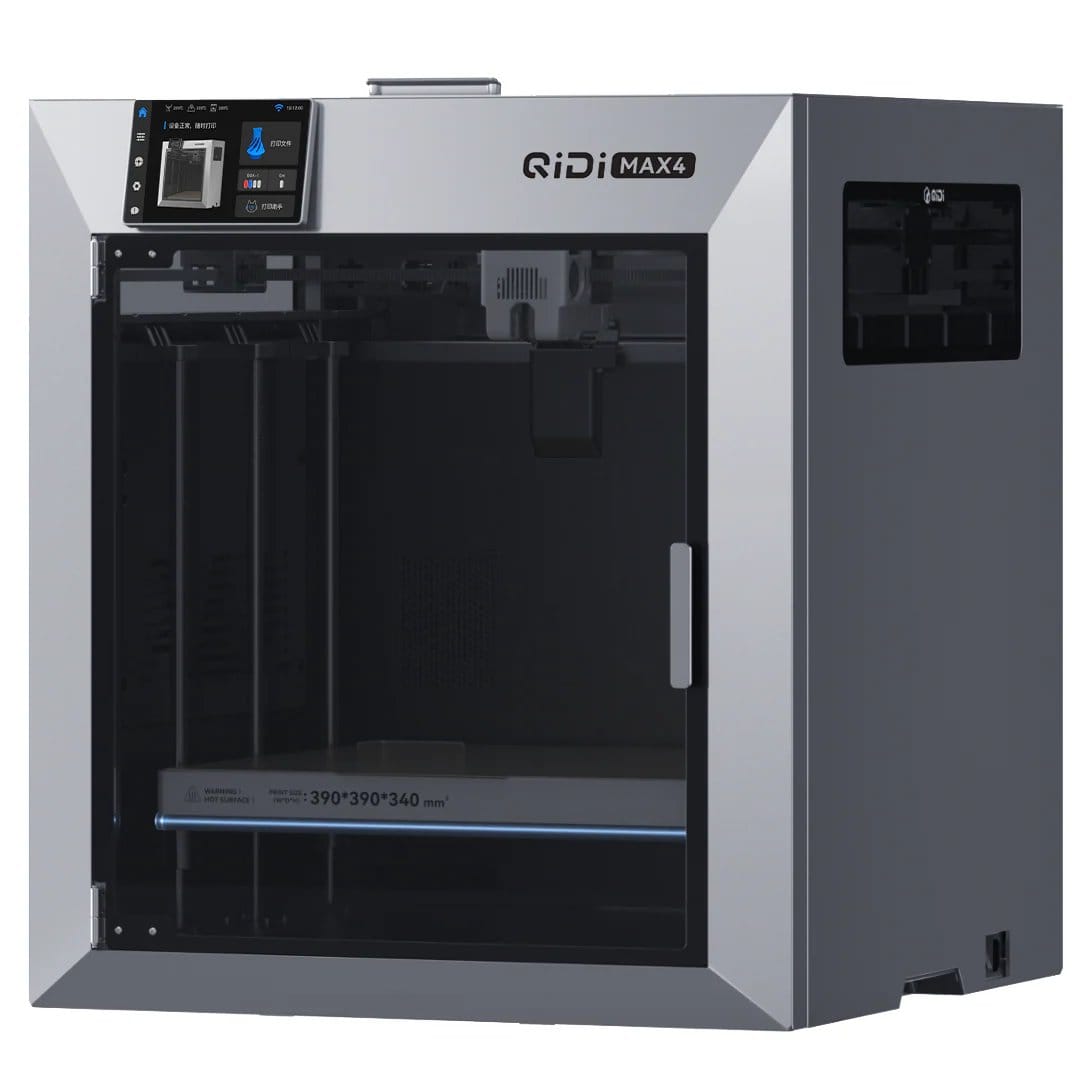
If you need engineering materials at large scale but the H2S at $1,199 is too steep, the Qidi Max 4 offers the same 65°C heated chamber for ~$1,099.
- Build Volume: 390 x 390 x 340 mm
- Price: ~$1,099
- Max Speed: 600 mm/s
- Key Features: 65°C active chamber, CoreXY, all-metal hotend
The Qidi matches the H2S's chamber temperature at a lower price, with a slightly wider XY build area (390 vs 340 mm). ABS, ASA, PA-CF, and polycarbonate all print reliably. CoreXY kinematics keep quality consistent at speed.
The tradeoff vs the H2S: no servo motors or vision encoder (standard steppers instead), no laser module option, and less polished software. Print results are genuinely good for functional engineering parts, but the out-of-box experience requires more manual involvement.
Pick this if: You need ABS/Nylon/PC at large scale and want to save ~$300 vs the H2S, and can live without the laser module and servo motor precision.
Largest 3D Printer for Home Use: Sovol SV08 MAX
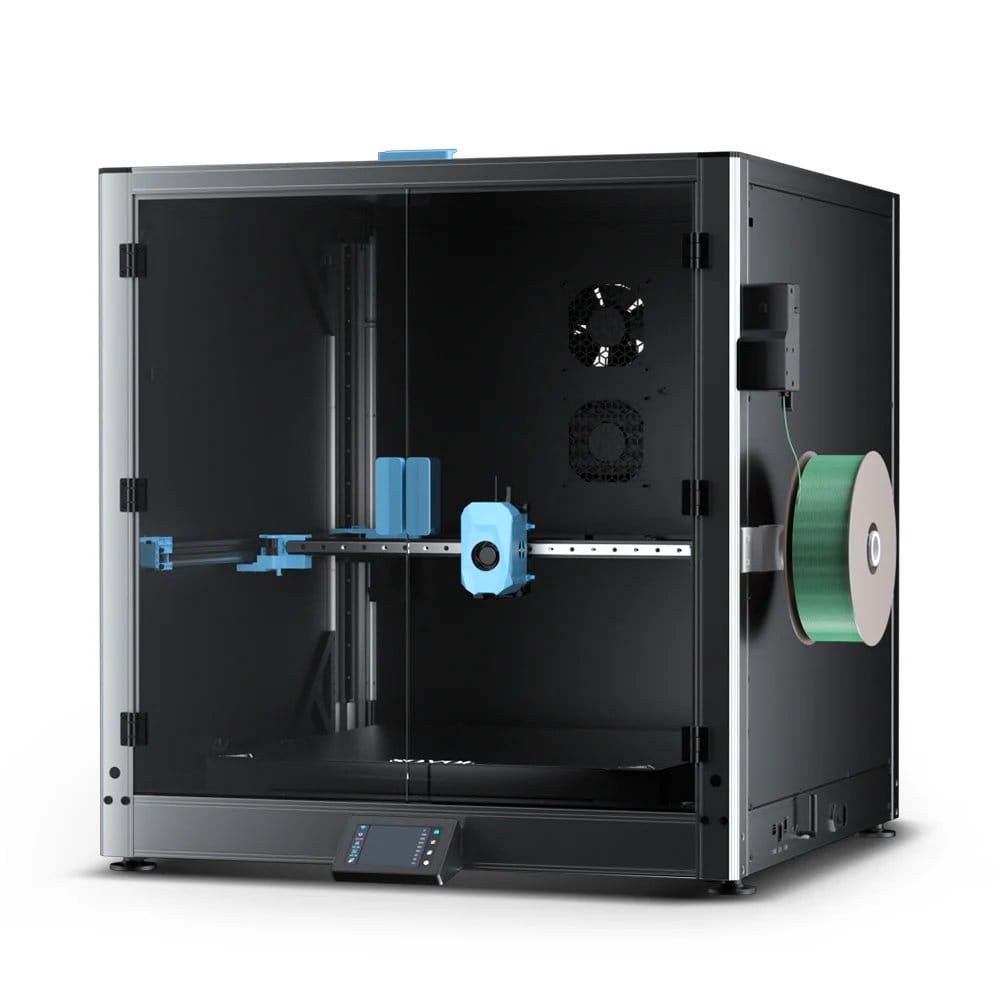
If your question is simply "what is the biggest consumer 3D printer I can buy," the answer is the Sovol SV08 MAX. At 500 x 500 x 500 mm (125 liters), this is a huge 3D printer that dwarfs everything else on this list.
- Build Volume: 500 x 500 x 500 mm
- Price: ~$800
- Max Speed: 700 mm/s
- Key Features: CoreXY, Klipper, auto leveling, half-meter cube
This machine prints furniture-scale items, full torso armor in one piece, large architectural models, and signage. Its physical footprint exceeds 700 mm in every direction, so this is a workshop machine, not a desk machine.
Open-frame, Klipper-based, requires technical comfort. This is not a beginner's first printer. But if you have experience and genuinely need half-meter prints, nothing else at this price comes close.
Pick this if: Your projects genuinely require 500 mm in one or more directions and you have workshop space.
Creality K2 Plus: Large Format 3D Printer with Enclosure and Multicolor
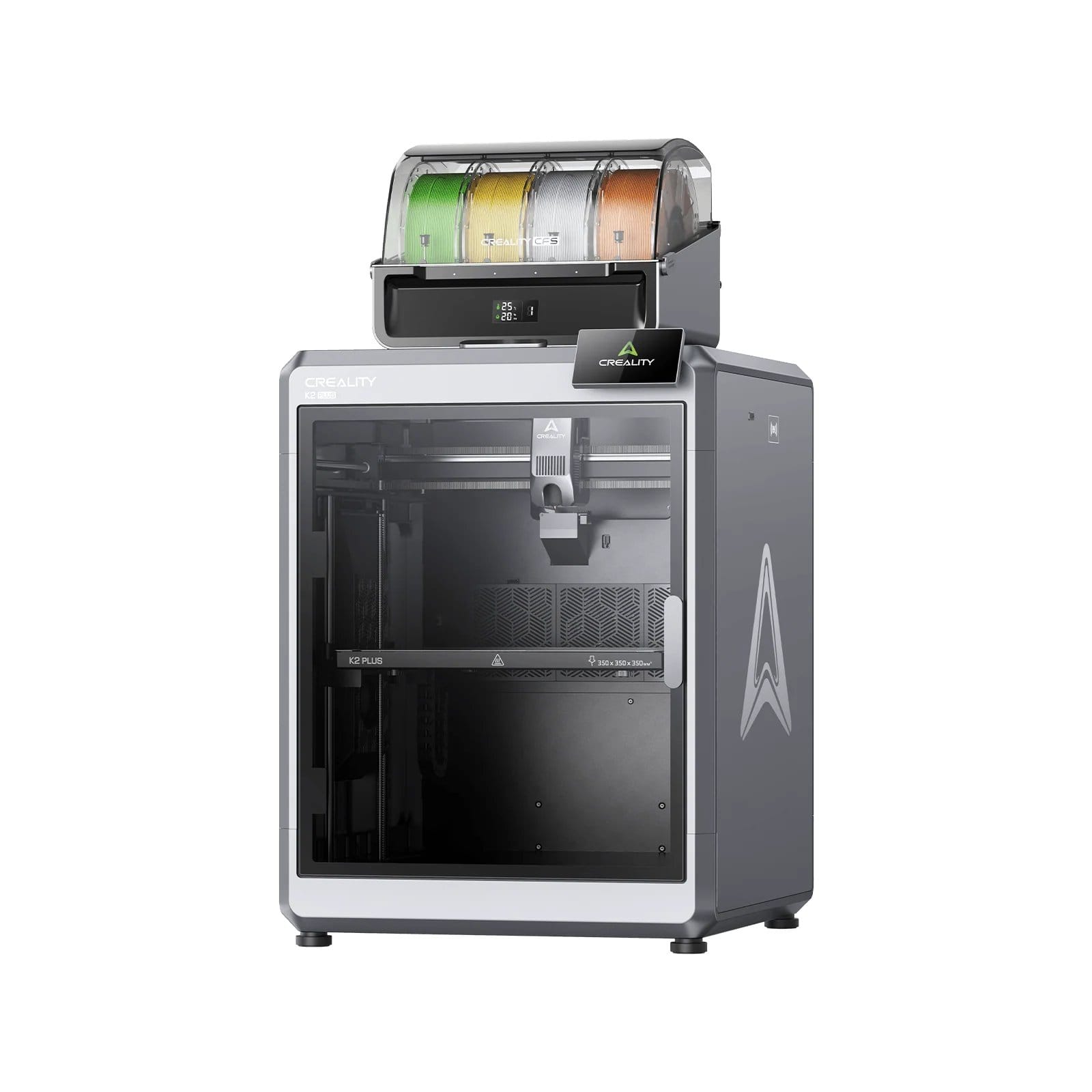
The Creality K2 Plus is the most direct competitor to the H2S from another brand. It offers an enclosed build, multi-color capability, and sits at the same ~$1,400 price point.
- Build Volume: 350 x 350 x 350 mm
- Price: ~$1,400
- Max Speed: 600 mm/s
- Key Features: Fully enclosed, CFS multi-color, auto-everything
The K2 Plus offers good auto-calibration, an enclosed frame for ABS/ASA, and Creality's multi-filament system. Compared to the H2S at the same price: slightly larger XY (350 vs 340 mm) but no active chamber heating (passive enclosure only), no servo motors, no vision encoder, no laser option.
Pick this if: You're already invested in the Creality ecosystem or found a significant price discount.
All Large Format 3D Printers Compared (2026)
| Printer | Build Volume | Enclosed | Speed | Price | Best For |
|---|---|---|---|---|---|
| Bambu Lab A2L ★ | 330×320×325 | No | 500 mm/s | $469-569 | Beginners, best overall |
| Bambu Lab H2S ★ | 340×320×340 | Yes (65°C) | 1000 mm/s | $1,199-1,799 | All-in-one, laser + engineering |
| Elegoo Neptune 4 Plus | 320×320×385 | No | 500 mm/s | ~$350 | Tightest budget |
| Anycubic Kobra 3 Max | 420×420×500 | No | 600 mm/s | ~$650 | Maximum volume per dollar |
| Qidi Max 4 | 390×390×340 | Yes (65°C) | 600 mm/s | ~$1,099 | Budget engineering materials |
| Sovol SV08 MAX | 500×500×500 | No | 700 mm/s | ~$800 | Absolute biggest prints |
| Creality K2 Plus | 350×350×350 | Yes | 600 mm/s | ~$1,400 | Creality ecosystem |
★ = Editor's Choice
What Can You Print with a Large Format 3D Printer?
Cosplay and props. Full-size helmets (Mandalorian, Iron Man, Stormtrooper), chest armor pieces, weapon replicas. With 330 mm+ build volume, most helmets print in one or two pieces instead of six.
Home decor. Large vases, lamp shades, wall art, planters. Items that fill a room rather than sitting small on a shelf.
Functional parts. Drone frames, camera rigs, large brackets, enclosure panels. Things that need structural integrity as one piece.
Batch production. Print 20-40 small items in one overnight run. The A2L's 330 mm plate fits significantly more items per batch than a standard 256 mm bed.
Education and display. Large anatomical models, architecture scale models, classroom demonstration pieces.
Do You Need a Large Format 3D Printer?
You need one if:
- Your projects regularly exceed 250 mm in any dimension
- You build cosplay armor or large props
- You want to batch-print many items per run
- Visible glue seams from split prints bother you
You probably don't if:
- Most prints fit in a 200 mm cube (phone cases, figurines, small tools)
- Desk space is limited (the A2L is 544×529 mm; the H2S is 492×514 mm)
- Budget is very tight (failed large prints waste more time and filament)
The alternative: Bambu Studio and other slicers can auto-split oversized models with alignment pins. You print the parts on a smaller machine and glue them together. For occasional large prints, this avoids buying a second machine.
Common Challenges of Large Format Printing
Warping at scale. The larger the base, the more thermal contraction pulls at corners. PLA on the A2L rarely has this problem. Engineering materials on open-frame printers need an enclosure (or buy the H2S/Qidi which include one). Using a brim helps on open-frame machines.
Long print times. Large detailed prints at 0.2 mm layer height can take 24-48 hours. Power loss recovery (standard on Bambu Lab) is essential. Filament tangles and nozzle clogs become higher-stakes problems over multi-day prints.
Filament consumption. A full-size helmet uses 500-800g per print ($10-20 in material). Failed prints hurt more when they're big.
First layer adhesion is critical. A 300 mm wide first layer needs perfect bed flatness and Z-offset across the entire surface. Auto bed leveling is essentially mandatory at this scale, and both the A2L and H2S include it.
Large Format 3D Printer vs Industrial 3D Printer
Many people searching for an industrial 3D printer actually want a high-performance desktop machine. Here's how they differ:
- Build volume: Consumer 300-500 mm vs Industrial 500-1800 mm
- Price: Consumer $350-$2,000 vs Industrial $10,000-$500,000+
- Materials: Consumer handles PLA, PETG, ABS, Nylon, PC. Industrial adds PEEK, ULTEM, metals
- Speed: Consumer 500-1000 mm/s. Industrial varies widely
- Setup: Consumer is plug-and-play to moderate. Industrial requires professional installation
- Examples: Consumer (Bambu H2S, Sovol SV08 MAX) vs Industrial (BigRep ONE, Modix Big-180X)
For home and small-business use, consumer large format printers deliver 90% of the capability at 5% of the cost. True industrial machines only make sense for production environments needing extreme size, exotic materials, or certified part quality.
The H2S in particular bridges this gap: it offers industrial-grade features (active chamber heating, servo motors, sub-50μm precision) in a desktop form factor at $1,199.
FAQ
What is the largest a 3D printer can print?
The largest consumer 3D printer is the Sovol SV08 MAX at 500 x 500 x 500 mm. Within the Bambu Lab lineup, the H2S is the largest at 340 x 320 x 340 mm. Industrial printers like the BigRep ONE reach 1000 x 1000 x 1000 mm, and construction 3D printers can produce entire building structures.
How much does a large format 3D printer cost?
Budget large format printers start at $350 (Elegoo Neptune 4 Plus). The best value for beginners is the Bambu Lab A2L at $469. Mid-range options with heated chambers cost $1,099-1,500 (Qidi Max 4, Bambu H2S, Creality K2 Plus). Industrial large-scale printers start at $10,000+.
What is the best large 3D printer for beginners?
The Bambu Lab A2L ($469) is the best large format 3D printer for beginners. It offers 330 x 320 x 325 mm of build volume with fully automatic calibration, zero-configuration setup, and Bambu Lab's plug-and-play ecosystem. No manual leveling or firmware knowledge required.
Are large 3D printers worth it?
Yes, if you regularly print objects larger than 250 mm or batch-print many items. The A2L at $469 makes large format accessible to hobbyists. If you mainly print small objects, a standard-size printer is more practical.
Can I find affordable large-format 3D printers for beginners?
Yes. The Bambu Lab A2L is the most affordable large-format 3D printer built for beginners in 2026. At $469 ($569 with multi-color AMS), it delivers 330 x 320 x 325 mm build volume with fully automatic calibration and one-touch setup. No manual leveling, no firmware configuration, no steep learning curve. The Elegoo Neptune 4 Plus (~$350) is even cheaper but requires more hands-on setup.