How Much Does 3D Printing Cost? A Complete Price Breakdown for Beginners
Real cost breakdown covering printers, filament, hidden expenses, and per-object prices for beginners.
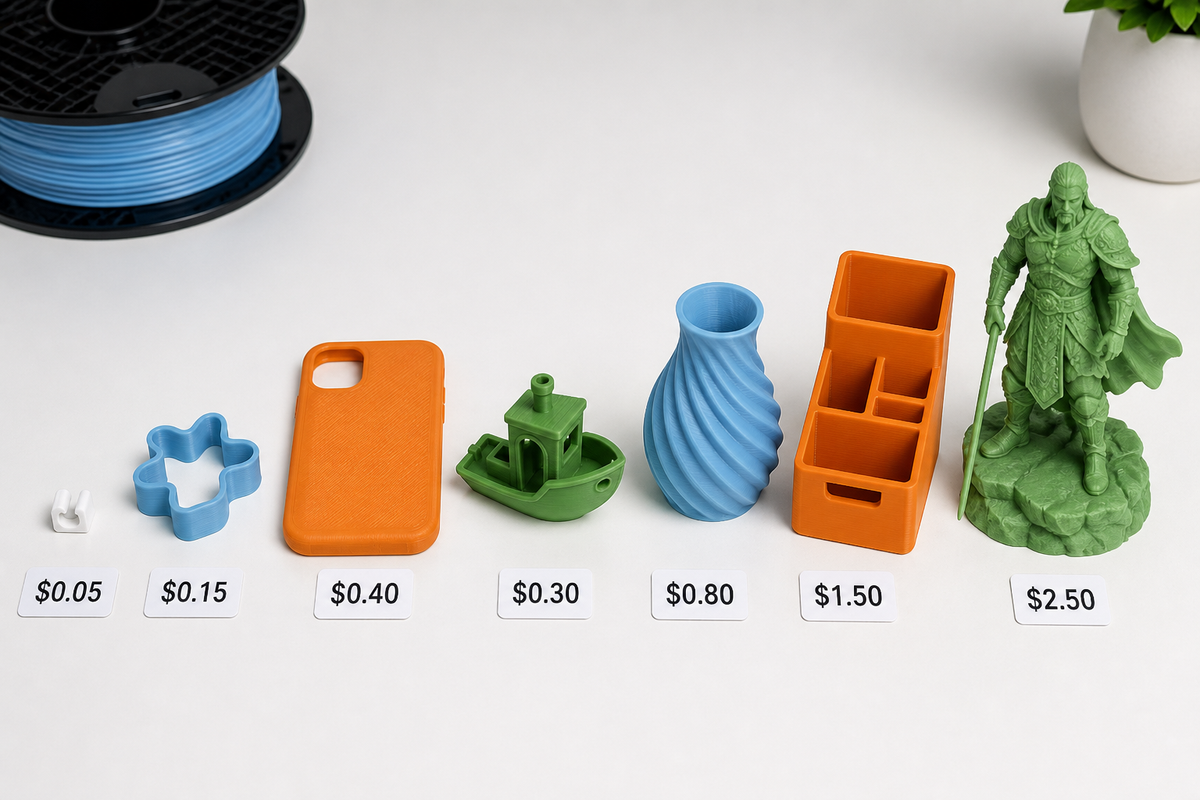
Is 3D printing expensive? The short answer might surprise you: most individual prints cost less than a dollar in materials. A phone case uses about $0.50 of filament. A small figurine costs around $1 to $3. Even a full cosplay helmet only uses $8 to $15 of plastic.
The bigger cost is the printer itself, which ranges from $100 for a basic kit to $600+ for a premium machine. But once you own one, the per-print cost of 3D printing is remarkably low.
This guide breaks down every cost you will actually face as a beginner, from the printer purchase to the filament to the hidden expenses nobody warns you about, with real numbers for real objects.
How Much Does a 3D Printer Cost in 2026?
The price range for home 3D printers is wide, but you do not need to spend a lot to get a capable machine. Here is what each price tier gets you.
Budget Printers ($100 to $250)
These are entry-level FDM printers that do a solid job for most beginner projects. They print slower than premium models and may require more manual calibration, but the print quality is perfectly good for functional parts, toys, and household items.
Popular models:
- Creality Ender 3 V3 SE (~$180): Auto bed leveling, direct drive extruder, decent speed. The most recommended budget printer in 2026.
- Elegoo Neptune 4 (~$200): Fast printing, PEI build plate, reliable out of the box.
- Artillery Sidewinder X4 Plus (~$230): Large build volume for the price.
Best for: Testing the hobby without a big investment, kids' first printer, schools.
Mid-Range Printers ($250 to $600)
This is the sweet spot for most beginners. You get high-speed printing, automatic calibration, Wi-Fi connectivity, and a camera for remote monitoring. These printers work well straight out of the box with minimal fiddling.
Popular models:
- Bambu Lab A1 Mini (~$200 to $300): Compact, fast, nearly zero setup. The most beginner-friendly printer available.
- Bambu Lab A1 (~$340 to $400): Larger build volume, AMS-compatible for multi-color printing.
- Bambu Lab P1S (~$500 to $600): Enclosed, handles engineering materials, excellent all-rounder.
- Creality K1 (~$350): High-speed, enclosed, good ecosystem.
Best for: Most beginners who want reliable results without constant troubleshooting.
Enthusiast and Prosumer Printers ($600 to $1,500+)
For users who want the absolute best print quality, multi-material capability, or large build volumes. Most beginners do not need to start here, but these printers are worth knowing about.
Popular models:
- Bambu Lab X1C (~$1,100 to $1,450): Top-tier FDM, full sensor suite, AMS for 16 colors.
- Bambu Lab H2S (~$1,399 to $2,099): Large format with laser module, servo motors.
- Prusa MK4S (~$600 to $800): Open-source, excellent community support, high reliability.
- Elegoo Mars 5 Ultra (~$250 to $350): Resin printer for ultra-detailed miniatures and figurines.
Best for: Power users, content creators, small business owners, resin vs filament comparisons.
How Much Does 3D Printer Filament Cost?
Filament is the plastic material FDM printers use. It comes in 1kg spools (about 2.2 pounds), and one spool lasts most beginners 2 to 4 weeks of regular printing.
| Material | Price per kg | Strength | Ease of Use | Best For |
|---|---|---|---|---|
| PLA | $12 to $25 | Moderate | Very easy | General purpose, decorative, beginners |
| PETG | $16 to $28 | High | Easy | Functional parts, outdoor items |
| ABS | $14 to $22 | High | Moderate (needs enclosure) | Heat-resistant parts, automotive |
| TPU | $20 to $35 | Flexible | Moderate | Phone cases, grips, gaskets |
| ASA | $18 to $30 | High | Moderate (needs enclosure) | Outdoor parts, UV-resistant |
| Specialty (carbon fiber, silk, wood-fill) | $25 to $50 | Varies | Moderate to hard | Visual effects, engineering |
| Resin (LCD/SLA) | $25 to $50/L | Brittle to tough | Easy to print, messy post-process | Miniatures, jewelry, dental |
How far does 1kg go? A single 1kg spool of PLA can produce roughly:
- 100+ small items (cable clips, keychains, hooks)
- 30 to 40 medium items (phone cases, small toys)
- 8 to 12 large items (vases, desk organizers)
- 2 to 3 very large items (helmets, laptop stands)
Most beginners use 3 to 6 spools in their first year, spending $50 to $120 on filament total. That makes the 3D printer material cost one of the cheapest ongoing expenses in any hobby.
How Much Does It Cost to 3D Print Common Objects?
This is the question most beginners actually want answered: how much does it cost to 3d print something specific? Here are real material costs calculated from actual slicer estimates using PLA at $20/kg ($0.02 per gram).
| Object | Weight (grams) | Material Cost | Electricity | Total Cost |
|---|---|---|---|---|
| Cable clip | 2g | $0.04 | $0.001 | ~$0.04 |
| Guitar pick | 2g | $0.04 | $0.001 | ~$0.04 |
| Keychain | 5g | $0.10 | $0.002 | ~$0.10 |
| Cookie cutter | 8g | $0.16 | $0.003 | ~$0.16 |
| Carabiner | 12g | $0.24 | $0.005 | ~$0.25 |
| Wall hook | 10g | $0.20 | $0.004 | ~$0.20 |
| Phone stand | 35g | $0.70 | $0.02 | ~$0.72 |
| Phone case | 25g | $0.50 | $0.015 | ~$0.52 |
| 3D Benchy (test boat) | 15g | $0.30 | $0.01 | ~$0.31 |
| Small figurine (50mm) | 20g | $0.40 | $0.015 | ~$0.42 |
| Articulated dragon | 60g | $1.20 | $0.05 | ~$1.25 |
| Desk organizer | 80g | $1.60 | $0.05 | ~$1.65 |
| Planter / vase | 50g (spiral mode) | $1.00 | $0.04 | ~$1.04 |
| Laptop stand | 120g | $2.40 | $0.08 | ~$2.48 |
| Large figurine (150mm) | 150g | $3.00 | $0.10 | ~$3.10 |
| Shelf bracket (pair) | 100g each | $4.00 | $0.12 | ~$4.12 |
| Lithophane (photo) | 30g | $0.60 | $0.03 | ~$0.63 |
| Cosplay mask (half face) | 200g | $4.00 | $0.15 | ~$4.15 |
| Full helmet (multi-part) | 400-600g | $8 to $12 | $0.40 | ~$8 to $12.50 |
| Chess set (32 pieces) | 300g | $6.00 | $0.30 | ~$6.30 |
Key takeaways:
- Most everyday prints cost under $2 in materials
- Electricity is essentially negligible (a 200W printer running for 3 hours costs about $0.05 at average US rates)
- The dominant cost for any single print is filament, and filament is cheap
- Supports and failed prints add to the real-world cost (covered in the next section)
How to calculate any print yourself:
- Slice your model in Bambu Studio, OrcaSlicer, or Cura
- Read the estimated weight (shown after slicing)
- Multiply by your filament's cost per gram (price per kg ÷ 1000)
For example: A model weighs 45g, your PLA cost $22/kg. That is 45 × $0.022 = $0.99 in material.
The Hidden Costs of 3D Printing Nobody Talks About
The printer and filament are the obvious expenses. But there are smaller costs that add up over your first year, and most buying guides skip them entirely.
Failed Prints
This is the single biggest hidden cost for beginners. In your first month, expect a 15 to 25% failure rate as you learn proper bed adhesion, support settings, and temperature tuning. A failed 3-hour print that used 60g of filament wastes about $1.20 in material and 3 hours of your time.
Realistic estimate for year one: $15 to $40 in wasted filament from failed prints. The rate drops sharply after the first few weeks as you learn what works. Checking our guide on 3D prints not sticking to the bed before your first print will save you most of these early failures.
Replacement Parts
- Nozzles: Wear out over time, especially with abrasive filaments. Brass nozzles are $2 to $5 each (budget 2 to 3 per year). Hardened steel nozzles ($8 to $15) last much longer. See our nozzle sizes guide for details.
- PEI build plate: The textured surface degrades after 6 to 12 months of heavy use. Replacements cost $15 to $30.
- PTFE tube: (on Bowden-style printers) Degrades at high temperatures. $3 to $8 replacement, once or twice per year.
Realistic estimate for year one: $20 to $50 in replacement parts.
Bed Adhesion Products
Most beginners start using adhesion helpers within the first week:
- Glue sticks: $3 to $5 (lasts months)
- Hairspray: $4 to $8 (lasts months)
- Magigoo or specialized adhesive: $15 to $20 (lasts months)
Many modern printers with PEI plates do not need any adhesion products for PLA, but you will likely try them anyway when prints start not sticking to the bed.
Realistic estimate for year one: $5 to $20.
Tools and Accessories
A basic tool kit for 3D printing is essential:
- Flush cutters (for removing supports): $5 to $10
- Scraper / spatula: $3 to $8
- Hex key set: $5 to $10 (often included with printers)
- Deburring tool: $5 to $10
- Isopropyl alcohol (for cleaning build plate): $5
- Sandpaper assortment: $5 to $10
Realistic estimate for year one: $25 to $50 for a solid starter toolkit.
Upgrades You Will Probably Want
Most beginners buy at least one or two of these within the first 6 months:
- Filament dry box: $15 to $40 (keeps filament moisture-free)
- Extra filament colors: $15 to $25 each (you will want more than the 1 to 2 spools you start with)
- LED work light: $10 to $20
- Webcam (if your printer lacks one): $20 to $40
- Enclosure (for printing ABS/ASA or reducing noise): $30 DIY to $100+ commercial
Realistic estimate for year one: $30 to $100, depending on how deep you go.
Safety Equipment
If you plan to print materials beyond PLA, you may need ventilation and safety gear. PLA produces minimal fumes at normal temperatures, but ABS, ASA, and resin require better precautions. Check our full guide on whether 3D printing is toxic for material-specific recommendations.
- Activated carbon filter: $10 to $25
- Small desk fan for ventilation: $15 to $30
- Nitrile gloves (for resin): $8 to $12 per box
Realistic estimate for year one: $0 if you stick with PLA, $20 to $50 if you branch out.
Your First-Year 3D Printing Budget: What to Expect
Here is what you will realistically spend in your first 12 months, broken down by three spending levels.
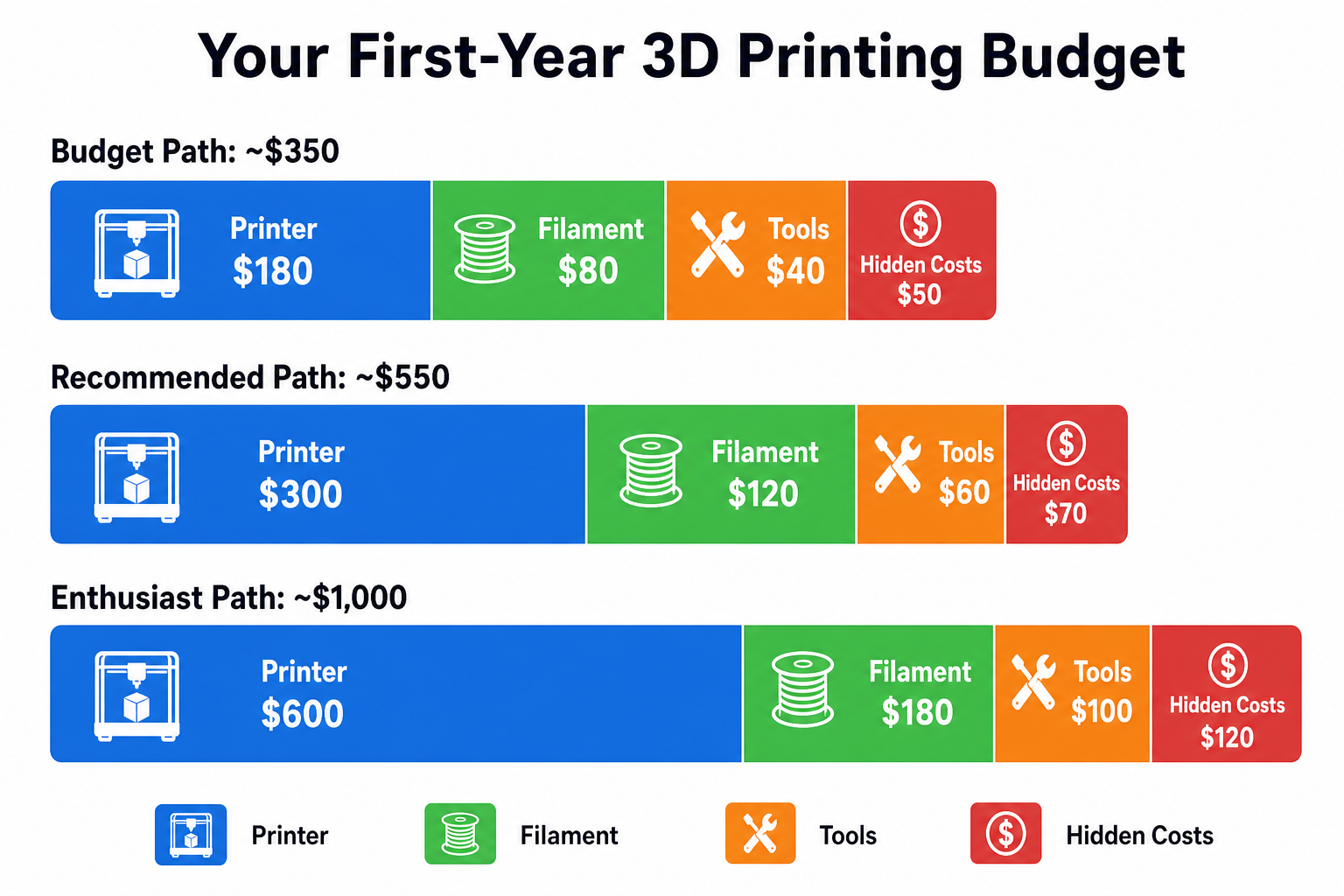
Budget Path (~$350 total)
| Category | Spending | Examples |
|---|---|---|
| Printer | $150 to $200 | Creality Ender 3 V3 SE, Elegoo Neptune 4 |
| Filament (3-4 spools) | $50 to $80 | PLA in 3-4 colors |
| Tools | $25 to $40 | Flush cutters, scraper, hex keys, IPA |
| Hidden costs | $30 to $50 | Failed prints, 1-2 nozzles, glue stick |
| Total | $255 to $370 |
Recommended Path (~$550 total)
| Category | Spending | Examples |
|---|---|---|
| Printer | $250 to $350 | Bambu Lab A1 Mini, Bambu Lab A1 |
| Filament (5-6 spools) | $80 to $120 | PLA + PETG, multiple colors |
| Tools | $40 to $60 | Full toolkit, sandpaper, deburring |
| Hidden costs | $50 to $70 | Failed prints, nozzles, dry box, adhesion |
| Total | $420 to $600 |
Enthusiast Path (~$1,000 total)
| Category | Spending | Examples |
|---|---|---|
| Printer | $500 to $700 | Bambu Lab P1S, Prusa MK4S |
| Filament (8-10 spools) | $130 to $200 | PLA, PETG, TPU, specialty |
| Tools | $60 to $100 | Full toolkit, work mat, LED light |
| Hidden costs | $80 to $120 | Enclosure, spare parts, safety, upgrades |
| Total | $770 to $1,120 |
The bottom line: You can start 3D printing for under $300, have a great experience for around $500, and go all-in for under $1,100. Compared to most technical hobbies (photography, woodworking, RC cars), 3D printing is one of the cheapest to get into and keep going.
Is 3D Printing Cheaper Than Buying? Real Comparisons
One of the most common questions beginners ask: is it actually cheaper to 3D print things than to just buy them? The answer depends on what you are printing and how often.
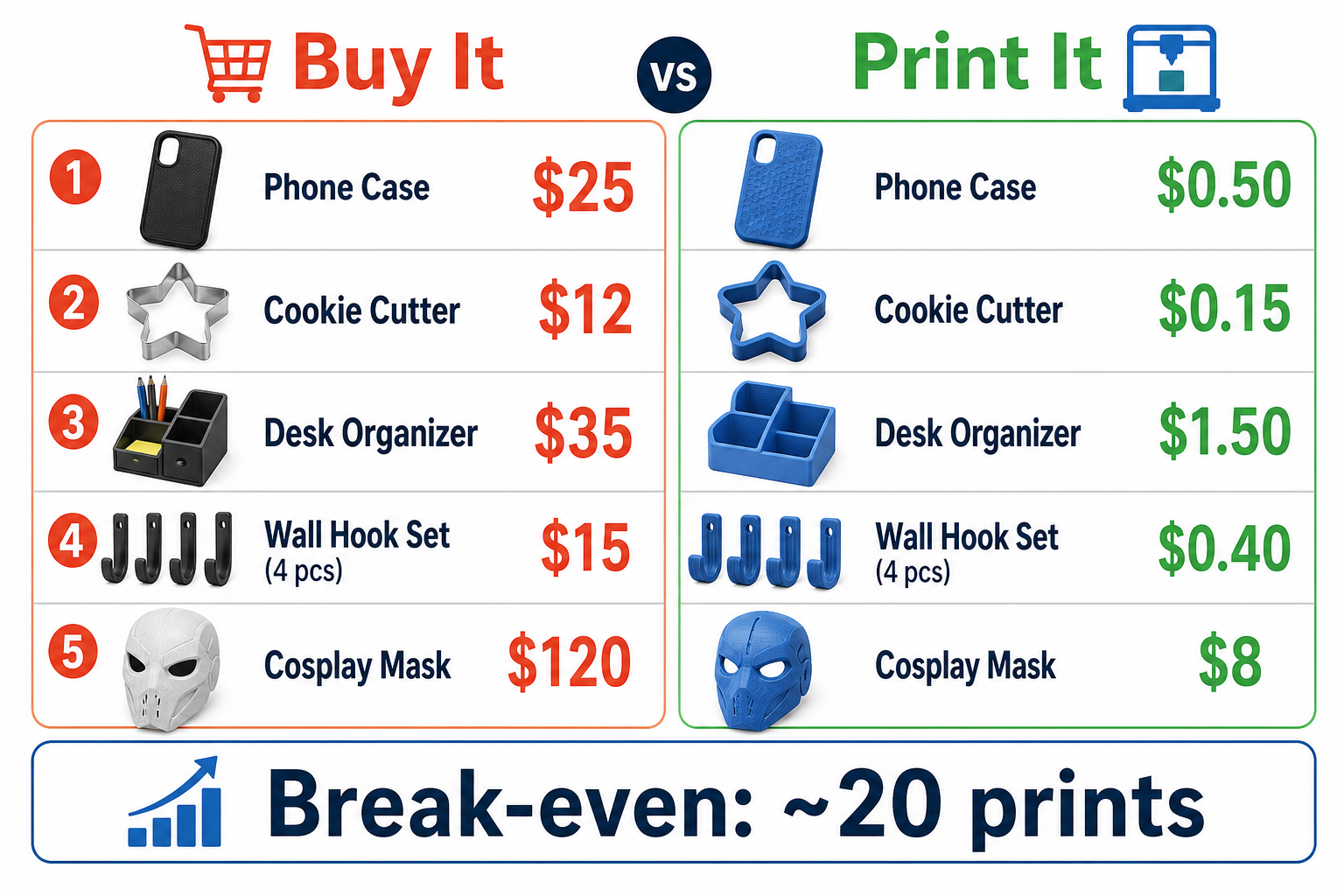
| Item | Retail Price (Amazon/Store) | 3D Print Material Cost | Savings per Item |
|---|---|---|---|
| Phone case | $15 to $30 | $0.50 | $14.50 to $29.50 |
| Custom cookie cutter | $8 to $15 | $0.15 | $7.85 to $14.85 |
| Desk organizer | $20 to $40 | $1.50 | $18.50 to $38.50 |
| Wall hooks (set of 4) | $12 to $18 | $0.40 | $11.60 to $17.60 |
| Cable management clips (10 pcs) | $8 to $12 | $0.30 | $7.70 to $11.70 |
| Plant pot / planter | $15 to $35 | $1.00 | $14 to $34 |
| Laptop stand | $25 to $50 | $2.50 | $22.50 to $47.50 |
| Cosplay mask | $80 to $200 | $4 to $8 | $72 to $192 |
| Board game inserts | $20 to $40 per set | $2 to $4 | $16 to $36 |
| Replacement knobs/handles | $5 to $15 each | $0.10 to $0.30 | $4.70 to $14.70 |
When 3D printing is clearly cheaper:
- Custom or personalized items (the retail premium for "custom" is huge)
- Items you need multiples of (the per-unit cost drops to almost nothing)
- Niche items that are overpriced online (specific phone case models, custom brackets)
- Replacement parts for appliances and furniture (a $0.10 print vs a $15 replacement part)
When buying is more practical:
- Items that need food-safe certification (printed items have layer lines that trap bacteria)
- High-strength structural parts (injection molded plastic is typically stronger)
- Items you only need once and can buy for under $5 (not worth the printer setup time)
- Anything with electronics or complex mechanisms
Break-even point: If your printer costs $300, and you save an average of $15 per printed item compared to buying, you break even after roughly 20 items. Most active hobbyists hit this within the first 2 to 3 months.
How to Reduce Your 3D Printing Costs
Practical ways to make each print cheaper without sacrificing quality where it matters.
Lower your infill density. Most prints default to 15 to 20% infill, but purely decorative items can use 5 to 10%. This reduces material usage by 10 to 20% with no visible difference on the outside.
Use a 0.6mm nozzle for non-detail prints. A larger nozzle prints wider lines, which means fewer passes, which means less time and slightly less material for the same strength. Practical for functional parts, prototypes, and anything where surface finish is not critical.
Print in vase/spiral mode when possible. Vases, pots, and cylinder shapes can be printed as a single continuous spiral wall. This uses 40 to 60% less material than a standard print with infill and is also much faster.
Minimize supports. Rotate your model to reduce overhangs. Use tree supports instead of grid supports (they use less material and are easier to remove). Design-aware orientation can eliminate supports entirely for many models.
Buy filament on sale. PLA regularly goes on sale during Amazon Prime Day, Black Friday, and Bambu Lab seasonal promotions. Buying 3 to 5 spools at $14 to $16 instead of $22 saves 30 to 40%. Store extra spools in a dry box or sealed bag with silica gel packets.
Fix adhesion problems early. Every failed print wastes filament, time, and electricity. Spending 10 minutes on proper bed leveling and first-layer tuning prevents the majority of failures. A clean build plate (wiped with isopropyl alcohol) solves most adhesion issues.
3D Printing Cost Calculator: How to Estimate Any Print
You do not need to guess how much a print will cost. Your slicer software calculates it automatically.
The Simple Formula
Material cost = Weight (grams) x Price per gram
Where price per gram = price per kg / 1000.
For a $20/kg spool of PLA: $20 / 1000 = $0.02 per gram.
Full cost formula (including everything): Total cost = Material cost + Electricity cost + Wear cost
- Material cost: weight × price per gram
- Electricity cost: print hours × printer wattage (kW) × electricity rate. A 200W printer at $0.12/kWh costs $0.024 per hour, about $0.07 for a 3-hour print.
- Wear cost: Estimated at $0.01 to $0.03 per print hour for nozzle, belt, and bearing wear on a home printer.
In practice, electricity and wear costs are so small that most hobbyists just calculate material cost and consider the rest negligible.
Using Your Slicer
Bambu Studio / OrcaSlicer: After slicing, the bottom bar shows estimated weight, filament length, and cost (if you have entered your filament's price per kg in the settings). The time estimate is also displayed, which you can use with our print time guide to plan ahead.
Cura: After slicing, weight and filament length appear in the bottom right corner. You can add cost per spool in the material settings for automatic cost estimation.
PrusaSlicer: Shows weight, filament used, and estimated time below the preview window after slicing.
Free Online 3D Print Cost Calculators
If you want a quick estimate before opening a slicer:
- PrintPal 3D Print Cost Calculator (printpal.io): Enter weight, filament cost, power usage, and hourly rate for a detailed breakdown
- 3DPrintPrice (3dprintprice.com): Simple weight-based calculator
- Omni Calculator (omnicalculator.com): Includes electricity and labor cost options
These are useful for ballpark estimates, especially if you are pricing prints for someone else.
How to Price 3D Prints for Selling
If you are thinking about selling prints on Etsy, at craft fairs, or to friends and colleagues, you need a pricing formula that covers your costs and your time. Here is how experienced sellers approach 3D print pricing.
The Standard Pricing Formula
Price = (Material cost x 2.5 to 3) + (Machine time x $2 to $5/hr) + Design/Setup fee
Example: A desk organizer (80g, 3 hours to print)
- Material: 80g x $0.02 = $1.60 x 3 = $4.80
- Machine time: 3 hours x $3/hr = $9.00
- Setup (slicing, removing, quality check): $2.00
- Selling price: $15.80, rounded to $16 or $18 with packaging
Pricing Benchmarks
Based on Etsy and marketplace data in 2026:
| Item Type | Typical Selling Price | Your Material Cost | Rough Margin |
|---|---|---|---|
| Small functional items (hooks, clips) | $5 to $10 | $0.10 to $0.30 | Very high |
| Phone cases | $12 to $25 | $0.50 | Very high |
| Figurines and toys | $15 to $40 | $1 to $4 | High |
| Planters and vases | $15 to $35 | $0.80 to $2 | High |
| Custom name plates / signs | $20 to $50 | $1 to $3 | High |
| Cosplay pieces | $40 to $150+ | $4 to $15 | Moderate (labor-heavy) |
When to charge more:
- Custom designs (add $10 to $50+ depending on complexity)
- Post-processing (sanding, painting, assembly) significantly increases labor time and value
- Rush orders (1.5x to 2x standard price is normal)
- Multi-color or multi-material prints (charge for filament swaps and setup)
When to price lower:
- Batch orders of identical items (setup cost is paid once)
- Simple, common designs that are widely available for free
Can You 3D Print Without Buying a Printer?
You do not actually need to own a 3D printer to try 3D printing. Several options exist for printing without the upfront investment.
Public Library Makerspaces
Many public libraries in the US, Canada, UK, and Europe now have makerspaces with free or low-cost 3D printing. You typically pay only for the material used ($0.10 to $0.25 per gram). Some libraries offer free printing up to a certain weight limit. Check your local library's website or ask at the reference desk.
University and School Labs
If you are a student, your school likely has a 3D printing lab. Many universities charge $0.05 to $0.15 per gram for students, making it the cheapest way to print. Some programs offer free printing for course-related projects.
Community Workshops and Fab Labs
Fab Labs and community makerspaces exist in most mid-size cities. Membership typically costs $30 to $100/month and includes access to 3D printers, laser cutters, CNC machines, and more. Useful if you want to try multiple tools before investing.
Online 3D Printing Services
Professional print-on-demand services let you upload an STL file and receive a finished print by mail:
| Service | Starting Price | Turnaround | Best For |
|---|---|---|---|
| JLC3DP | ~$1 to $5 for small parts | 3 to 8 days | Cheap FDM and resin prints |
| Craftcloud (by All3DP) | Varies (price comparison) | 5 to 14 days | Comparing multiple providers |
| Shapeways | $5 to $20+ | 7 to 14 days | Nylon, metal, specialty materials |
| Xometry | Quote-based | 3 to 10 days | Professional/industrial quality |
When a service makes sense: If you need one or two prints per year, ordering from a service is cheaper than owning a printer. If you need prints monthly or more, owning a printer pays for itself quickly.
My Year-One Cost Experience
I will share the honest numbers from my first 12 months of 3D printing. I bought a Bambu Lab A1 Mini ($250 at the time), which was the best decision I made because it eliminated most of the troubleshooting that would have wasted filament on a cheaper machine.
In year one, I went through 7 spools of PLA and 1 spool of PETG, spending about $140 on filament. I replaced one nozzle ($8), bought a set of flush cutters ($7), a deburring tool ($6), and a filament dry box ($25). I had maybe 8 to 10 failed prints in the first month, which wasted about $15 in filament. After that, my failure rate dropped to under 5%.
My total first-year spending came to roughly $450. I printed over 200 objects, ranging from tiny cable clips to large vases and several gifts for friends. That works out to about $2.25 per finished object, including the cost of the printer itself. By the second year, with the printer already paid for, my per-object cost dropped to about $0.80.
The things I printed would have cost well over $2,000 to buy at retail. A single custom laptop stand ($40 retail, $2.50 to print), custom phone cases for every family member ($100+ retail, $3 total to print), and dozens of household organizers that do not exist in stores at any price. The printer paid for itself many times over.
FAQ
How much does it cost to 3D print a figure or figurine?
A small figurine (50 to 70mm tall) costs roughly $0.40 to $1.00 in PLA filament on an FDM printer. A larger, highly detailed figurine (150mm+) costs $3 to $6 in material. If you use a resin printer for finer detail, the material cost is slightly higher at $1 to $3 for small figures and $5 to $10 for larger ones, but you also need to account for $0.50 to $1 of isopropyl alcohol per print for washing. For a custom figurine of yourself from a 3D scanning service, expect to pay $50 to $200+ including the scanning, modeling, and printing, since the labor is the major cost.
How much does it cost to get someone to 3D print something for you?
Online services like JLC3DP charge $1 to $10 for small to medium FDM prints, plus $3 to $8 shipping. Local print shops and Etsy sellers typically charge $10 to $40 for a standard print, with custom design work adding $20 to $100+ depending on complexity. The per-print price from a service is higher than doing it yourself, but you avoid the upfront cost of buying a printer. If you only need a few prints per year, a service is the more economical choice.
Is 3D printing actually cheaper than buying things?
For individual items, 3D printing is almost always cheaper in material cost. A phone case costs $0.50 to print vs $15 to $30 to buy. A desk organizer costs $1.50 to print vs $25 to $40 to buy. However, you need to factor in the one-time cost of the printer ($200 to $600). Once you account for the printer purchase, the break-even point is roughly 15 to 25 printed items where the cumulative savings exceed the printer cost. Most active hobbyists reach this within 2 to 3 months. After that, every print represents pure savings compared to buying retail.
How much does it cost to 3D print a small object?
Very small objects like cable clips, keychains, guitar picks, and small hooks cost $0.04 to $0.25 in filament. They use 2 to 12 grams of material and print in 5 to 30 minutes. Even at premium filament prices, you would struggle to spend more than $0.50 on any small object. This is why 3D printing is especially cost-effective for small functional items, replacement parts, and custom hardware that would be disproportionately expensive to buy individually.
How much does 3D printing cost per gram?
With standard PLA filament ($18 to $25 per kg), the cost per gram is $0.018 to $0.025. PETG runs $0.016 to $0.028 per gram. Standard resin costs $0.025 to $0.050 per gram (per mL, since resin density is close to 1g/mL). In practical terms, most hobby prints use 10 to 100 grams of material, putting the material cost at $0.20 to $2.50 per print for the vast majority of projects.